
Australian Cobberdog vs Labradoodle: Understanding the Difference
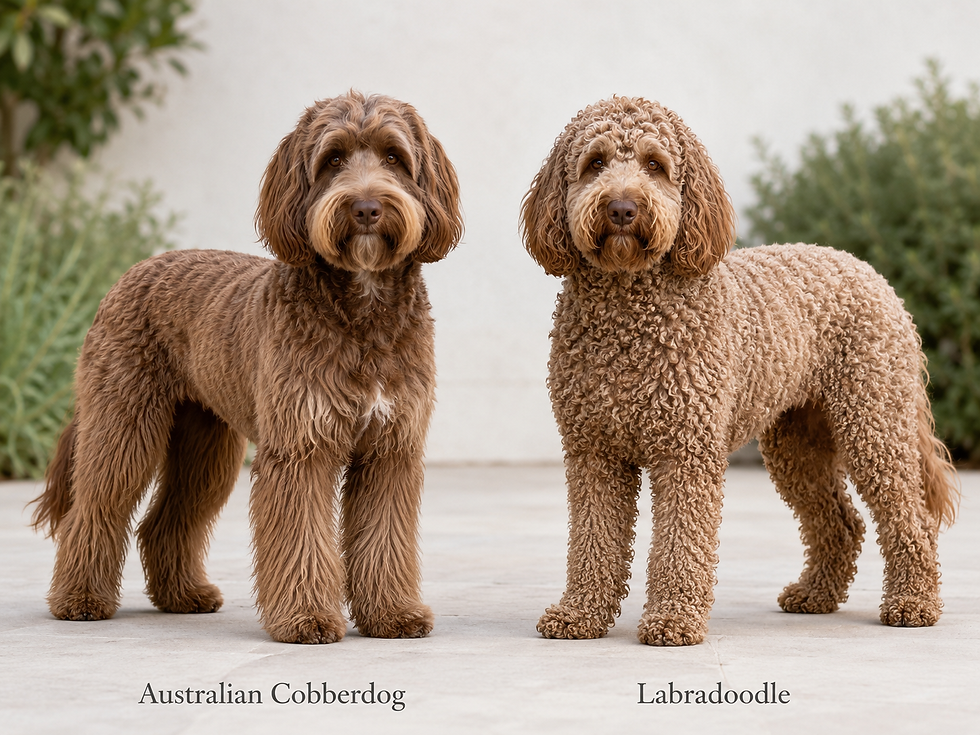
They may share some history and can look similar, but an Australian Cobberdog and a Labradoodle are not simply two names for the same dog.
For families beginning their puppy search, the terms Labradoodle, Australian Labradoodle and Australian Cobberdog can be confusing. Photographs alone do not always make the difference obvious, and the names are sometimes used interchangeably online.
However, each name describes a different breeding pathway.
The most important distinction is not whether a dog has a curly, wavy or fleece coat. It is the dog’s documented ancestry, the breeding standard being followed and the registry in which its pedigree is recorded.
First, There Are Three Different Terms
Before comparing the breeds, it helps to separate three names that are often grouped together:
Labradoodle
Australian Labradoodle
Australian Cobberdog
Although their histories overlap, they are not identical.
What Is a Labradoodle?
The term Labradoodle generally describes a dog produced from Labrador Retriever and Poodle ancestry.
A first-generation Labradoodle—often described as an F1—is the direct offspring of a Labrador Retriever and a Poodle. Other Labradoodles may be bred back to a Poodle or may come from several generations of Labradoodle breeding.
Because the term is used broadly, there is no single worldwide Labradoodle registry, pedigree system or breed standard that applies to every dog carrying the name.
As a result, Labradoodles can vary considerably in:
Size and structure
Coat type and shedding
Temperament and energy
Appearance
Health-testing requirements
The predictability of their adult characteristics
This does not mean that a Labradoodle cannot be a wonderful dog. Many are deeply loved family companions. It does mean that the word Labradoodle by itself provides limited information about how the dog has been bred, what standards were followed or what records exist behind it.
What Is an Australian Labradoodle?
An Australian Labradoodle is not simply a Labradoodle that was born in Australia.
The name describes a multigenerational breeding population developed from early Labradoodle lines. Australian Labradoodle organisations maintain their own pedigrees, breeding rules and breed standards.
The Australian Labradoodle Association of Australia describes the Australian Labradoodle as having Labrador Retriever, Poodle and Cocker Spaniel foundations. Its registered dogs come from multigenerational lines rather than being limited to first-generation Labrador–Poodle crosses.
This means that a responsibly bred and registered Australian Labradoodle also has a distinct identity and should not be confused with every dog advertised under the general Labradoodle name.
What Is an Australian Cobberdog?
The Australian Cobberdog developed from selected early Australian Labradoodle lines, followed by a separate and carefully documented breeding pathway. Its ancestry includes several breeds that contributed to the earlier population, together with the controlled introduction of Irish Soft Coated Wheaten Terrier genetics during the breed’s development.
In 2012, the Australian Cobberdog was accepted by the Master Dog Breeders and Associates as a breed in development under its own name. From that point, the Australian Cobberdog was recorded as a separate breed population with its own pedigree records and breed standard.
The word cobber is an Australian term for a trusted friend or companion. The name reflects the breed’s intended character: a socially connected dog developed with a strong focus on human companionship.
The Australian Cobberdog Society now supports the continued development of the breed through a dedicated registry, breed standard and structured breeding framework. The Society places particular emphasis on health, temperament, sound structure and the distinctive ability of the Australian Cobberdog to form close human connections.
An Australian Cobberdog is therefore not identified by appearance alone. It should belong to a documented Australian Cobberdog pedigree population.
Where Did Their Histories Separate?
The Australian Cobberdog and Australian Labradoodle share historical roots, but their development did not remain under one unified breeding program.
Different organisations established their own:
Pedigree databases
Breeding rules
Accepted foundation lines
Breed standards
Registration requirements
Long-term goals for breed development
One significant point of difference was the controlled introduction of selected Irish Soft Coated Wheaten Terrier genetics into the developing Australian Cobberdog population. According to the breed founders, these dogs were chosen for qualities including their flowing coat, balanced structure, defined neck and shoulders, sturdy limbs and gentle temperament. This infusion was not adopted by the Australian Labradoodle registries and became part of the separate developmental pathway of the Australian Cobberdog. It is one of several historical influences within the breed’s documented ancestry, rather than a recent or ongoing cross used to produce individual puppies.
This is why it is more accurate to say that the Australian Cobberdog and Australian Labradoodle are related through their early history but are now being developed under different registries and breed frameworks.
Neither name should be used as a substitute for the other.
The Difference at a Glance
Labradoodle
Usually refers broadly to Labrador Retriever and Poodle crosses or their descendants. The name alone does not confirm a particular registry, pedigree, breed standard or generation.
Australian Labradoodle
A multigenerational breeding population developed from Labradoodle foundations, with pedigrees and standards maintained by Australian Labradoodle organisations.
Australian Cobberdog
A separately named breed-development population with its own documented pedigrees, registry framework and breed standard. Its development places strong emphasis on health, soundness, temperament, human connection and suitability as a family companion.
Is an Australian Cobberdog a Purebred Dog?
The word purebred can create confusion because it is sometimes used differently by breeders, registries and national kennel organisations.
The Australian Cobberdog is best understood as a developing breed with a defined breed standard and documented studbook population.
Developing a breed is a long-term process. It requires more than producing dogs with a similar appearance. Breeders must record ancestry, monitor health, select for temperament and structure, manage genetic diversity and work towards greater consistency over successive generations.
The ACS registry includes structured pathways for breed development, including the controlled introduction of appropriate foundation genetics when needed to preserve genetic diversity. Dogs move through recorded generations before entering the established Australian Cobberdog population.
This work is important because closing a small gene pool too quickly can create future health problems. Responsible breed development must balance consistency with adequate genetic diversity.
Can You Identify an Australian Cobberdog by Looking at It?
Not reliably.
Australian Cobberdogs are known for their expressive eyes, balanced appearance, flowing coat and engaging connection with people. However, Labradoodles, Australian Labradoodles and other Poodle crosses can sometimes have a similar appearance.
A photograph cannot confirm:
The dog’s parentage
Its registration
Its health history
The breeding standard followed
Whether its litter was recorded
Whether the breeder belongs to an accountable organisation
The most reliable evidence is the dog’s pedigree and registration record.
A pedigree is more than a decorative certificate. It records the dog’s identity and ancestry, enabling breeders to follow health, temperament and genetic relationships across generations.
Are Australian Cobberdogs Hypoallergenic?
Australian Cobberdogs are generally bred for a low-shedding coat, but no breeder or organisation should promise that any dog will be completely allergy-free.
Dog allergies are commonly triggered by proteins found in saliva, skin and dander rather than by hair alone. Research has not found sufficient evidence to describe any breed as universally hypoallergenic. Individual people may also react differently to individual dogs.
Families managing dog allergies should discuss their circumstances with a medical professional and spend time around adult Australian Cobberdogs before committing to a puppy.
Low shedding should also not be confused with low maintenance. The Australian Cobberdog coat requires regular brushing, thorough combing and professional grooming.
Does the Name Guarantee Temperament or Health?
No name, registration certificate or breed label can guarantee the health or temperament of an individual puppy.
Responsible breeding improves the information available to breeders and puppy buyers, but development is influenced by several factors, including:
Genetics
The health and temperament of both parents
Early puppy development
Socialisation
Training
The puppy’s home environment
The individual nature of the dog
Registration provides traceability. It does not replace careful breeding, appropriate health testing or thoughtful puppy raising.
This is why puppy buyers should consider both the dog’s pedigree and the practices of the breeder.
What Should Puppy Buyers Ask?
Before paying a deposit, ask the breeder to explain:
Where are the parents registered?Ask for the registered names and numbers of both parents.
Will the litter and every puppy be registered?Being told that the parents are registered does not automatically mean the litter will be.
Will the puppy receive an individual pedigree certificate?The certificate should connect the puppy to its recorded parents and ancestry.
What health testing has been completed?Ask to see the actual results rather than accepting statements such as “DNA clear” or “vet checked.”
Which breed standard does the breeder follow?A responsible breeder should be able to explain the characteristics they are working to preserve or improve.
How are breeding decisions made?Colour and appearance should never be the only priorities. Health, temperament, genetic diversity and structural soundness all matter.
Why Does the Distinction Matter?
The purpose of explaining the difference is not to suggest that every Australian Cobberdog is better than every Labradoodle.
The distinction matters because families deserve to know what they are purchasing.
When someone chooses an Australian Cobberdog, they should receive more than a puppy with a particular appearance. They should receive a dog whose identity can be traced through a documented pedigree and whose breeder is working within an established framework for the breed’s health, temperament and future development.
Clear naming also protects the integrity of each population. Australian Labradoodle breeders should be able to preserve their own history and standards, just as Australian Cobberdog breeders should accurately identify and register the dogs they produce.
How Can I Confirm That a Puppy Is an Australian Cobberdog?
Do not rely only on an advertisement, social-media page or verbal assurance.
Before proceeding, puppy buyers should:
Confirm that the breeder is listed with a recognised Australian Cobberdog registry
Ask for the registered names of the puppy’s parents
Confirm that the planned litter will be registered
Request copies of the parents’ health-testing results
Ask when the puppy’s individual pedigree will be issued
Read the breeder’s contract before paying a deposit
An ethical breeder will welcome informed questions and should be willing to explain their registration, health testing and breeding program clearly.
The Most Important Difference
The simplest way to understand the distinction is this:
A Labradoodle is generally identified by the breeds used to produce it. An Australian Cobberdog is identified through its documented pedigree, registry population and the breed standard guiding its continued development.
They share part of their history, but today they represent different breeding identities.
When looking for an Australian Cobberdog puppy, look beyond the coat, colour and photographs. Check the breeder, verify the health results and make sure the puppy will receive registration and a pedigree confirming that it is part of the documented Australian Cobberdog population.
Find an ACS Approved Breeder
ACS Approved Breeders work within shared health, welfare and breeding standards, register their litters and pedigrees, and contribute to the documented Australian Cobberdog population being developed for the future.
Before choosing your puppy, search the ACS breeder directory and verify that the breeder is currently registered with the Australian Cobberdog Society.

Comments